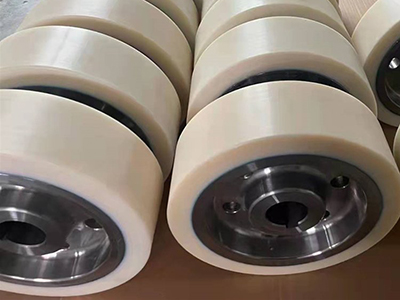
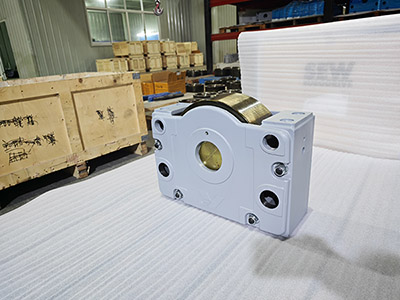
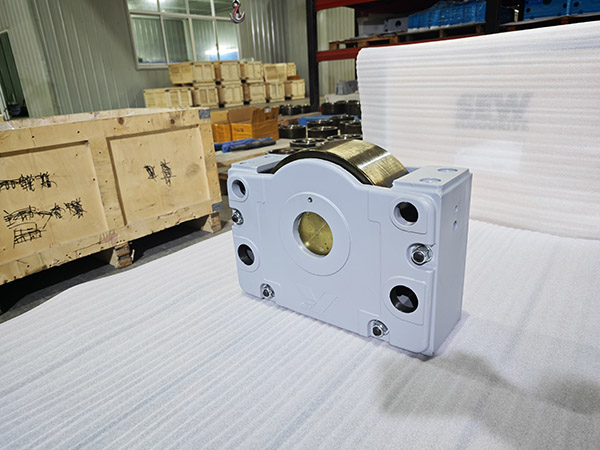
The DRS 315 wheel block system serves as a core travel component in the field of automated warehousing and heavy-duty material handling. Boasting a remarkable single-wheel load capacity of up to 22 tons, a precision five-side machining process, and a highly convenient modular installation, it perfectly aligns with the rigorous operational demands of AS/RS stacker cranes for "height, speed, accuracy, and stability." Starting from the inherent technical characteristics of the DRS 315, the following sections will further elaborate on its key applications and value within the bottom travel mechanism of stacker cranes.
Core Technical Characteristics
1. High Load Capacity: The DRS 315 is a medium-to-large specification within the wheel block series. Protected by a high-strength steel castingor spheroidal graphite cast iron (e.g., GGG 70) housing, its maximum permissible wheel load can reach 180 kN to 220 kN (approx. 18 - 22 tons)per wheel, making it ideal for heavy-duty industrial applications.
2. Precision Housing Design: The wheel block housing is typically machined on five sides, providing exceptionally high mechanical dimensional accuracy. This ensures perfect alignment of the travel wheels during installation, effectively preventing "rail gnawing" (track wear) and significantly reducing running noise.
3. Versatile Wheel Tread Profiles: ①Double-flanged or single-flanged profiles used for standard rail guidance.
②Without Flanges (Flat Tread): Relies on external horizontal guide rollers for track steering.
4. Extremely Simple Installation & Maintenance:Featuring multiple standard connecting faces (top, side, and pin connections), the system allows for rapid overall assembly and disassembly without the need for complex, time-consuming alignment checkups during replacement.
Combined Application of DRS 315 and Stacker Cranes
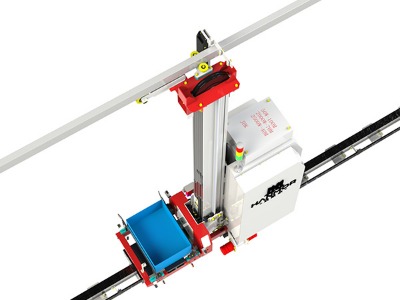
In automated storage and retrieval systems (AS/RS), stacker cranes operate under extreme conditions characterized by high masts, heavy payloads, frequent start-stop accelerations, and high positioning accuracy. As the core of the travel mechanism bottom chassis, the DRS 315 wheel block system supports the smooth operation of the stacker crane in the following four ways:
1. Withstanding Massive Vertical Wheel Loads and Dynamic Overturning Moments
When a stacker crane is fully loaded, lifting goods at high elevations, or braking urgently, the mast generates severe eccentric loads as well as forward and backward inertial moments. Utilizing an integrated steel casting housingand heavy-duty bearings, a single DRS 315 wheel can stably withstand a vertical wheel load of up to 18–22 tons. Meanwhile, its rigid structure effectively resists dynamic impacts during startup and braking phases, safely transferring overturning forces to the ground rails and preventing dangerous swaying of the tens-of-meters-high mast.
2. Matching High-Frequency, High-Acceleration Direct-Drive Transmission
Modern automated warehouses demand extremely high throughput efficiency, with stacker cranes often reaching horizontal travel speeds of 160 to 240 m/min. The splined hollow shaft (or hollow shaft with parallel key) design of the DRS 315 wheel block allows the gear motor to be directly connected via a rigid "torque-arm/suspended" mounting. This direct-drive transmission eliminates the mechanical backlash found in traditional couplings, allowing the motor's driving torque to be transferred to the rail instantly and losslessly—perfectly matching the high-frequency, high-acceleration start-stop cycles of stacker cranes.
3. Supporting Millimeter-Level Precision Travel and Positioning
Stacker cranes must achieve a precise stopping accuracy of ±2mm within aisles that can extend over a hundred meters. The five-side precision machining process of the DRS 315 housing guarantees strict parallelism and coaxiality between the front and rear wheels, fundamentally eliminating track alignment errors that cause "rail gnawing." In practical applications, they are typically paired with horizontal guide rollers that clamp both sides of the rail. This restricts the lateral oscillation of the stacker crane chassis to a minimal range, providing a stable mechanical foundation for laser or barcode positioning systems.
4. Minimizing Equipment Maintenance Downtime
If an AS/RS stacker crane shuts down due to travel wheel wear, the entire logistics chain paralyzes. The internal bearings of the DRS 315 feature a lifetime pre-lubricated and fully sealed design, requiring virtually zero routine maintenance. When the wheel finally reaches the end of its service life, the modular design allows maintenance personnel to simply loosen the chassis connection bolts for a rapid, "plug-and-play" swap out of the entire block. This eliminates the need for complex on-site wheel realignment, minimizing downtime losses.