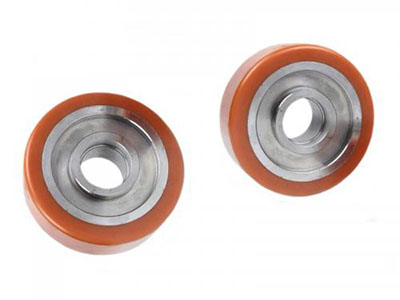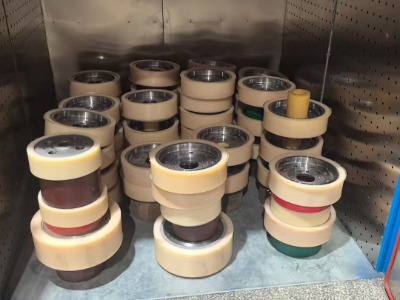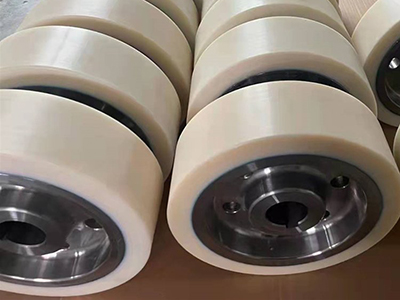
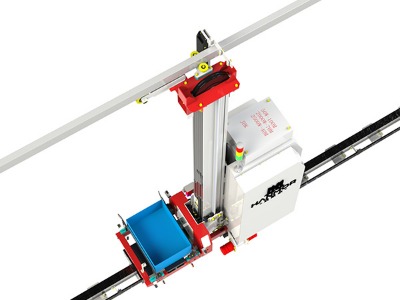
Urethane Guide Wheels for Stacker Cranes are indispensable precision control components within Automated Storage and Retrieval Systems (AS/RS). While travel wheels are responsible for driving and bearing the vertical payload of the stacker crane, guide wheels are engineered for "track alignment and stabilization." Typically installed on the sides of the stacker crane's top (top guide rail) or bottom (ground rail) assemblies, these wheels hug the sides of the steel tracks. This ensures that the massive crane structure maintains absolute straightness, tracking stability, and balance during high-speed, reciprocating movements.
Core Materials & Manufacturing Process
The operating conditions for guide wheels involve high frequencies, fast linear speeds, constant reversing, and heavy lateral impacts. Consequently, the material selection and engineering standards are exceptionally rigorous:
1. Tread Layer (Polyurethane): Formulated from premium polyurethane elastomers (such as NDI or PPDI modified polyurethanes). These materials deliver exceptional high resilience and low dynamic heat build-up. Under frequent lateral compression, the tread resists permanent deformation and eliminates the risk of debonding caused by internal overheating.
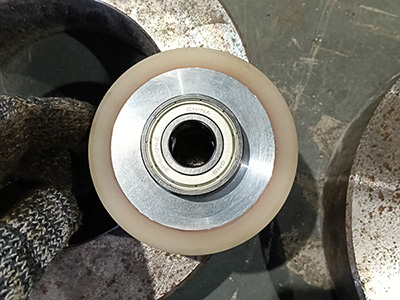
2. Wheel Core & Bearing Integration: Core structures are precision-machined from high-strength steel or steel castings, often featuring directly integrated, dual-row precision ball bearings or heavy-duty bearings. The steel casting core securely locks the bearings in place, ensuring no cracking or axial displacement even under intense side-impact forces.
Key Technical Features & Advantages
1. Eliminates Snaking & Guarantees Travel Precision: During rapid acceleration or emergency braking, stacker cranes are highly prone to swaying or "snaking" due to inertia. High-hardness, high-elasticity polyurethane guide wheels provide rigid yet cushioned lateral constraints, securing the alignment needed for precise laser positioning and servo system targeting.
2. Superior Lateral Impact & Compression Resistance: Rail joints, minor track misalignments, or shifts in the crane’s center of gravity generate instantaneous, heavy side-loads. Premium polyurethane possesses extreme tear strength and impact resistance to effectively buffer and absorb these forces.
3. Track Protection & Near-Silent Operation: Compared to traditional steel guide wheels, the polyurethane tread dampens running noise (typically keeping it under 60 dB) and causes zero wear to the steel rails. This dramatically lowers maintenance costs and extends the lifespan of the entire rail infrastructure.
4. Minimal Rolling Resistance: The optimized elastomer formulation ensures that while the wheels firmly hug the track sides, they create minimal parasitic drag, thereby maximizing the energy efficiency of the main drive system.
Technical Parameters
Guide wheels are generally more compact than primary travel wheels, though they demand higher precision in their parameters:
| Model | Dimension | Wheel diameter (mm) | Wheel width (mm) | Axle dimension (mm) | Load capacity (kgs) |
| SC85 | 85 × 85 | 85 | 85 | 20 | 600 |
| SC110 | 110 × 35 | 110 | 35 | 20 | 300 |
| SC200 | 200 × 70 | 200 | 70 | 30 | 1100 |
| SC250 | 250 × 100 | 250 | 100 | 40 | 2000 |
| SC360 | 360 × 120 | 360 | 120 | 50 | 3500 |
| SC400 | 400 × 150 | 400 | 150 | 60 | 4800 |
Application Scenarios & Customization
This product is widely utilized in AS/RS high-bay warehousing cranes across industries such as pharmaceuticals, new energy lithium-ion batteries, tobacco, and cold-chain logistics.
Our Customization Edge:
Because top and ground rail profiles, along with installation clearance constraints, vary widely by stacker crane OEM, we offer comprehensive OEM/ODM customization services:
We can customize bearing seats, integrated axles, snap-ring grooves, or stepped wheel profiles directly from your engineering drawings.
To match extreme travel velocities 180 to 300 m/min, our engineering team tailors specific polyurethane formulations to completely eliminate common high-speed failure points such as edge chipping, delamination, or internal thermal meltdown.