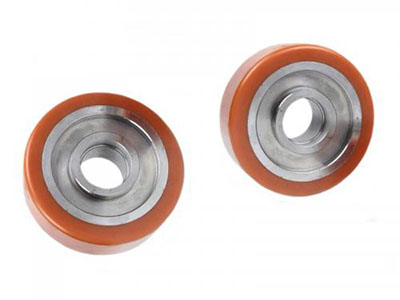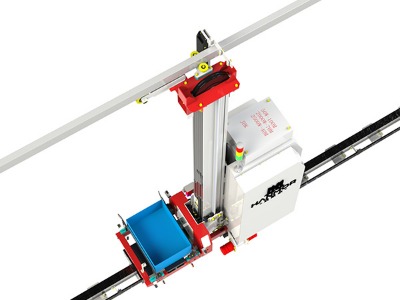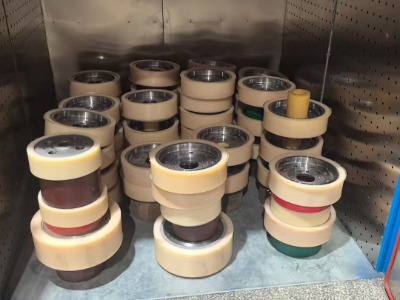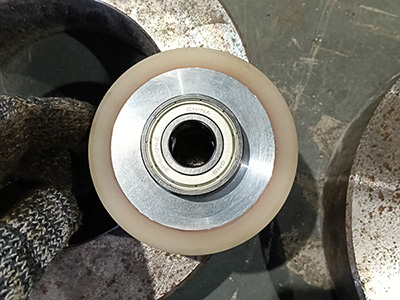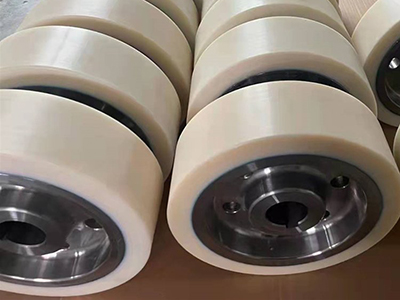
“Modern Automated Storage and Retrieval Systems require hydrolysis-resistant guide rollers to ensure long-term mechanical integrity and prevent premature material degradation in high-humidity or temperature-controlled environments. ”
In the world of modern logistics automation, Stacker Cranes serve as the backbone of Automated Storage and Retrieval Systems (AS/RS). However, as cold chain logistics, food processing, and high-humidity industrial environments become more prevalent, many operators are finding that traditional polyurethane wheels are failing prematurely—often within a year—due to cracking, debonding, or surface softening. The culprit behind this failure is a chemical reaction known as Hydrolysis.
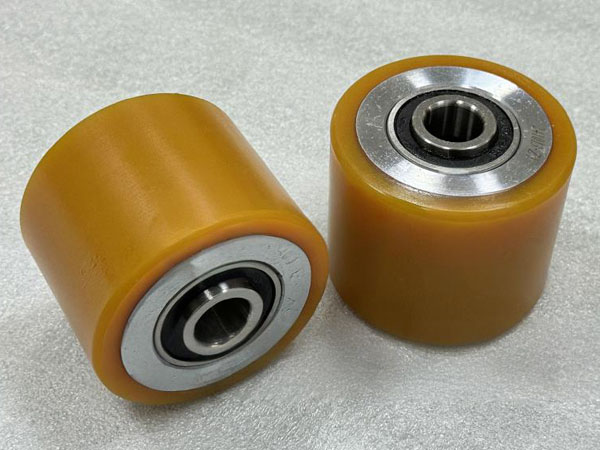
What is Polyurethane Hydrolysis?
Polyurethane (PU) is formed by reacting isocyanates with polyols. In humid environments, water molecules attack the ester groups within the polymer chain, leading to the cleavage of these molecular bonds.
This chemical degradation manifests physically as:
1. Loss of Hardness: The roller softens, leading to decreased tracking precision.
2. Physical Debonding: The bond between the wheel hub and the polyurethane tread fails.
3. Surface Micro-cracking: Small cracks rapidly expand under high-speed reciprocating motion.
Why Hydrolysis Resistance is Now an "Industry Standard"
1. The Expansion into Extreme Environments
Modern AS/RS are no longer confined to climate-controlled warehouses. In cold chain environments (-25°C), frequent temperature fluctuations cause condensation; in high-humidity regions, ambient moisture is enough to trigger the degradation of conventional materials.
2. Durability Requirements for High-Frequency Operation
Modern stacker cranes demand extreme acceleration and travel speeds. Utilizing Hydrolysis Resistant Polyurethane Guide Rollers ensures that physical properties remain stable under complex moisture conditions, significantly reducing costly unplanned downtime.
3. Balancing Load Capacity with Wear Resistance
Historically, increasing hydrolysis resistance often meant sacrificing dynamic load capacity. However, next-generation elastomers—through molecular chain modification—not only resist moisture but also provide the low rolling resistance and high dynamic load-bearing capacity required for High-load Stacker Crane Wheels.
Technical Comparison: Conventional vs. Next-Gen Hydrolysis Resistant Materials
Feature | Standard Polyester PU | Next-Gen Elastomer (NDI/PPDI Based) |
Moisture Resistance | Poor (Hydrolyzes easily) | Excellent |
Operating Temp Range | -20°C to 60°C | -40°C to 90°C |
Tear Strength | Moderate | High |
Service Life | 6-12 Months (Humid) | 36+ Months |
Conclusion
Choosing guide rollers with hydrolysis resistance is no longer an optional upgrade—it is a necessity for ensuring the efficient and safe operation of modern automated warehouses. By investing in high-performance materials, enterprises can significantly lower their Total Cost of Ownership (TCO) and eliminate the risk of systemic logistics shutdowns at the source.