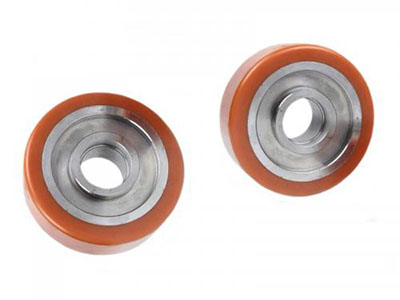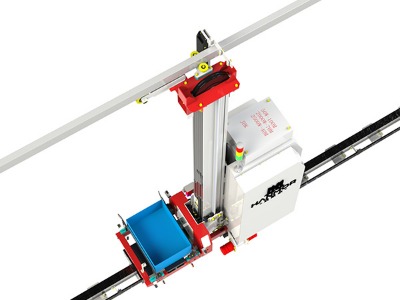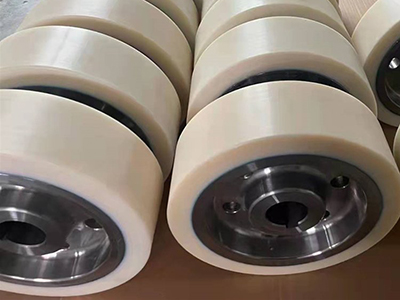
“Our stacker crane drive wheels provided for UAE clients are bolted directly into the travel units, perfectly overcoming the extreme high temperatures of the Gulf region and completely eliminating unscheduled downtime caused by delamination.”
Customer
The United Arab Emirates (UAE) serves as a hyper-connected global hub for logistics and supply chain management. Driven by the rapid expansion of modern industrial zones in Dubai and Abu Dhabi (such as JAFZA and KIZAD), high-density Automated Storage and Retrieval Systems (AS/RS stacker cranes) have become standard infrastructure.
The end-user for this project is a large-scale, modern logistics center in the UAE, operating across e-commerce, cold chain food storage, or third-party logistics (3PL). Due to the unique geographical location of the Middle East, the stacker crane systems must not only endure high-frequency, heavy-duty 24/7 operations but also overcome the challenges of the region’s extreme climatic conditions.
Requirement
Operating in the UAE introduces harsh environmental variables. The client demands stringent performance indicators for the stacker crane drive wheels to prevent premature failure:
1. Extreme Heat and Humidity Resistance: Summer ambient temperatures in the UAE frequently exceed 45°C, with even higher spikes in non-air-conditioned or transitional warehousing zones. Standard polyurethane wheels are highly susceptible to hydrolysis (molecular degradation) or softening under these conditions.
2. Excellent Heat Build-up Control: Stacker cranes operate in ultra-narrow aisles with frequent "start-accelerate-decelerate-brake" cycles. With travel speeds often exceeding $200text{ m/min}$ and accelerations reaching up to 0.45m/s, high dynamic loads generate massive internal hysteresis heat. The wheel material must exhibit ultra-low rolling resistance to prevent internal overheating, which leads to delamination or "blowouts."
3. High Dynamic Load Capacity: Heavy-duty pallet stacker cranes carry total weights of several tons. The drive wheels must withstand massive vertical dynamic pressures and intense horizontal shear forces during emergency braking.
4. Anti-Slip and Precision Positioning: AS/RS systems rely heavily on laser positioning. The wheel tread must maintain a highly stable coefficient of friction to eliminate slippage during rapid acceleration or abrupt stops, ensuring system positioning accuracy at a 2 mm.
5. Low Noise and High Wear Resistance: Modern logistics centers enforce strict workplace noise limits. The drive wheels must provide excellent vibration dampening and noise reduction while maintaining an exceptionally low wear rate over years of high-frequency operation.
Solution
To address these critical requirements;
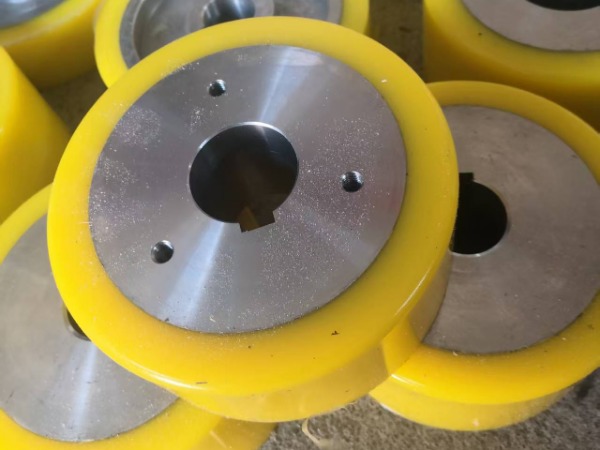
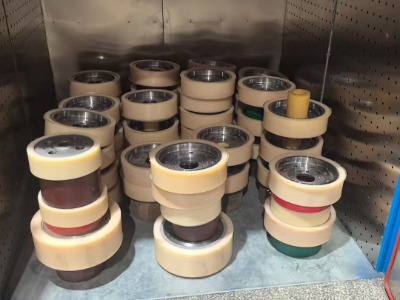
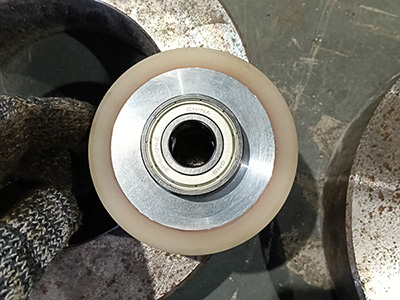
we utilizes a high-performance, hydrolysis-resistant, high-purity NDI polyurethane elastomer (Hardness: Shore A 93-95) for the drive wheel tread, fundamentally eliminating the risks of material hydrolysis and internal heat build-up (blowouts) under the UAE’s extreme hot and humid climate. The wheel core is machined from high-strength 45# forged steel or 42CrMo, undergoing precise CNC turning and multi-stage surface treatments; paired with advanced hot-vulcanization bonding technology (bonding strength 12 N/mm², it completely prevents delamination under extreme braking shear forces. Furthermore, pre-installed SKF/FAG high-precision double-row bearings—packed with heat-resistant synthetic grease and protected by double-lip seals—strictly prevent desert dust and sand ingress, fully guaranteeing long-term, stable operations under high-frequency and heavy-duty conditions.
Solution Summary:
Our drive wheel solution is more than a simple replacement; it is a material-level re-engineering specifically tailored for the Middle Eastern climate. By leveraging high-dynamic NDI materials and rigorous vulcanization standards, we help operators reduce unscheduled maintenance downtime by over 40%, fully securing 24/7 uninterrupted efficiency for the UAE's modern logistics hubs.